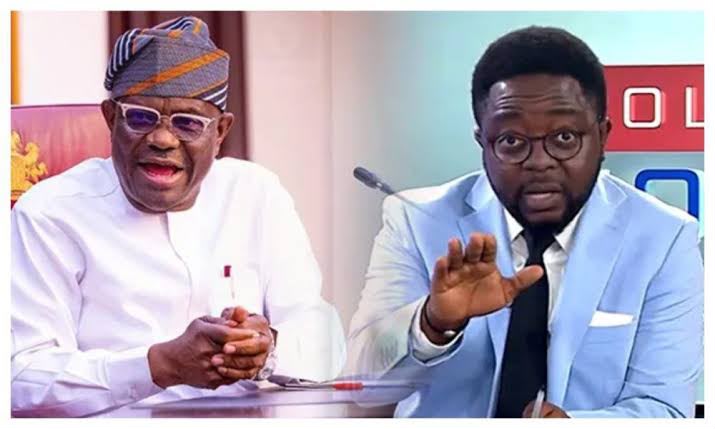
On Friday 3 April, at a media parley in Abuja, the Minister of the Federal Capital Territory, Nyesom Wike, said of a Channels Television anchor: “If there is any way to break the screen, I would have shot him.” The following day we issued a statement calling that what it is – a direct threat to press freedom and to democratic accountability.
What was said
The remark was directed at Seun Okinbaloye, who had raised concerns on Politics Today about the possibility of Nigeria drifting towards a one-party state, given the leadership crisis in the African Democratic Congress, and about what that would mean for opposition politics ahead of the 2027 elections.
That is ordinary political journalism. It is the work of asking a question in public that a great many Nigerians are asking in private.
Our position
In a statement signed by our Communications Officer, Esther Martins, and issued on Saturday 4 April, we said that such a remark from a person holding public office is unacceptable and constitutes a direct threat to press freedom and democratic accountability.
“This represents a pattern by Nigerian authorities to shrink the civic space by intimidating journalists and inducing self-censorship.”
– Foundation for Digital Justice
What we demanded
We demanded that Minister Wike issue a public retraction of his threat and a public apology to Seun Okinbaloye within 24 hours, and said that failing that, we would pursue all available legal remedies to seek accountability.
Why words like these do their work without being carried out
Nobody seriously expects a minister to shoot a television presenter. That is not the point, and treating it as the point is how a threat of this kind escapes scrutiny.
The effect of a public official saying such a thing is not on the one journalist named. It falls on every editor deciding which questions are worth the trouble, and on every reporter weighing a line of inquiry against the risk of becoming the next example. That is what self-censorship is: not an instruction obeyed, but a calculation quietly made. It leaves no record, and it is precisely why the civic space narrows without anyone appearing to close it.
A threat against one journalist is therefore never only about that journalist. It undermines free expression, media freedom and democratic governance as a whole – which is why it warrants a response rather than a shrug.
Defending the people who ask uncomfortable questions in public is part of our wider work on free expression and digital rights. You can read more about our approach to strategic litigation and policy advocacy.